1
Specific Bacterial Populations
Exercise studies sometimes find differences in the relative abundance of particular microbial groups. The exact organisms reported are not consistent enough to define one universal “exercise microbiome.”

Exercise can affect many systems throughout the body, and researchers are increasingly studying whether regular physical activity also changes the gut microbiome. Human studies have found differences in microbial composition between active and less-active people, but the relationship is more complex than saying exercise automatically creates a “better” microbiome.
Exercise type, training history, intensity, diet, medications, body composition, sleep and other lifestyle factors can all overlap with microbiome findings. That makes it important to separate genuine research observations from exaggerated claims about particular bacteria or diversity scores.
If you are new to microbiome science, start with What Is the Microbiome? . This page focuses specifically on physical activity and what researchers have observed in the gut microbiome.

Does exercise change the gut microbiome? Research suggests that physical activity can be associated with changes in specific gut microbial populations and aspects of microbial composition. However, there is no single microbiome change that occurs in everyone who exercises, and current evidence does not show a consistent universal increase in microbiome diversity.
Physical activity changes energy use, circulation, metabolism, gastrointestinal function and many other biological processes. Those changes create several possible pathways through which exercise could interact with microorganisms living in the digestive tract.
Human research has therefore compared athletes with non-athletes, physically active adults with less-active adults, and people before and after structured exercise interventions.
The results suggest that exercise can influence the microbiome, but researchers still have difficulty separating physical activity from other differences in people's lives.
Diet is especially important. Athletes and active adults may consume different amounts of fiber, protein, carbohydrates, total energy, supplements and fluids than comparison groups.
To understand this overlap, review Microbiome and Diet . Exercise findings are easier to interpret when dietary patterns are not ignored.
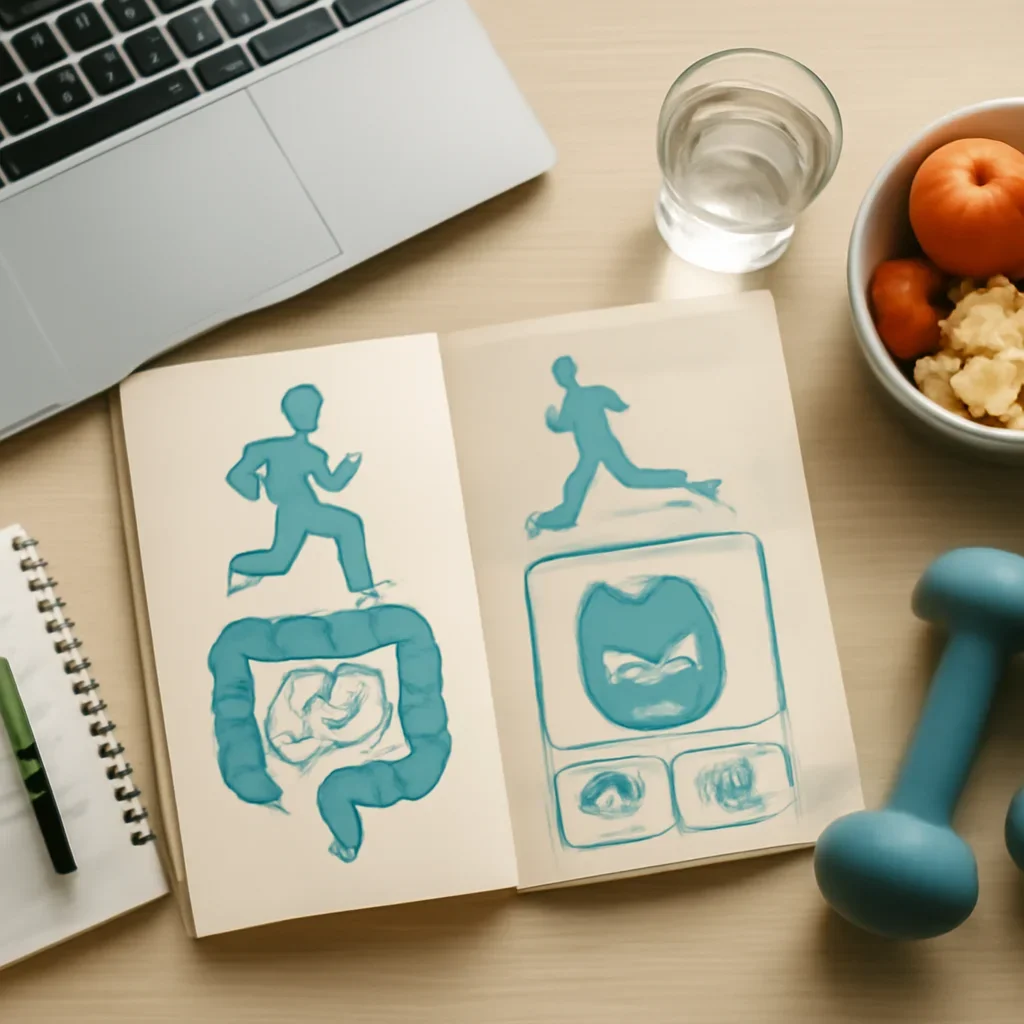
Microbiome studies do not look at one single measurement. Researchers may examine individual microbial groups, diversity, community structure and microbial functions or metabolites.
Exercise studies sometimes find differences in the relative abundance of particular microbial groups. The exact organisms reported are not consistent enough to define one universal “exercise microbiome.”
Researchers can examine whether the overall microbial community differs between active and inactive groups or changes during an exercise intervention.
Some studies report greater richness or diversity in active people, especially athletes. However, recent meta-analysis has not shown a consistent overall effect of physical activity on alpha-diversity.
Exercise may influence parts of the gut microbial community, but a research finding about one bacterial group or diversity measure should not be turned into a rule that applies to every person.
Probably, but researchers have not established one exercise formula for producing a particular gut microbiome. Studies use different training programs, participant groups and sequencing methods, which makes direct comparison difficult.
No. Microbiome research does not support a simple rule that increasingly intense or prolonged exercise always produces increasingly beneficial microbiome changes.
Studies of endurance athletes and prolonged exercise have reported a mix of findings. Researchers have examined changes in microbial populations, gastrointestinal symptoms, intestinal permeability and microbial metabolites, but results vary between studies.
This is another reason athlete studies should not automatically be used to tell the general population what their microbiome should look like.
Gut microbiome research should not be used as a reason to dramatically increase exercise intensity or volume. Exercise decisions should be based on appropriate health and fitness guidance rather than trying to create a specific microbiome profile.
This is difficult, and it is one of the most important limitations in exercise–microbiome research.
People who exercise regularly may also eat differently, sleep differently, use different supplements, spend different amounts of time outdoors or have different body composition from people who are less active.
A systematic review specifically examining whether physical activity can influence the microbiome independently of diet found suggestive evidence, but also highlighted the limited number of studies that adequately controlled dietary differences.
That means a microbiome difference observed in an athlete should not automatically be attributed to exercise alone.
A consumer microbiome test can provide information about microorganisms represented in the submitted stool sample. Depending on the report, this may include bacterial composition, relative abundance and diversity-related information.
What the test cannot establish is whether exercise caused a particular result or whether your training program is effective.
Even when someone tests at two different points in time, a difference between reports can have several possible explanations. Diet, medication, illness, travel, supplements, sample timing and ordinary biological variation may all be relevant.
Understand the sample, analysis method, report format and intended use rather than assuming a gut test measures fitness.
Review the Sample Report so you can see which microbiome measurements are actually provided.
A microbiome difference does not prove that your workout routine produced that change or that the change is beneficial or harmful.
If exercise or sports nutrition research has led you to search for a microbiome test in your area, the MicrobiomeTest.us process is designed around at-home collection rather than requiring a routine visit to a local clinic.
Customers order online, receive the collection kit at their delivery address, collect the required stool sample at home, return it using the supplied instructions and review the report after laboratory processing.
The state and city pages provide geographic guidance for people ordering from different parts of the United States. They should not be interpreted as listings for separate MicrobiomeTest.us walk-in laboratories in every location.
Location is mainly relevant to ordering, delivery and sample-return logistics. Your city does not create a separate “local exercise microbiome” or change how microbiome research should be interpreted.
Exercise–microbiome science is still developing. These human systematic reviews help explain why this page avoids claiming that exercise produces one predictable gut microbiome result.
A systematic review of randomized controlled trials found that exercise-related microbiome changes appear to depend on exercise type, intensity and intervention duration, with effects often appearing in specific microbial populations rather than consistent changes in overall diversity. Review the PubMed record .
A systematic review and meta-analysis including more than 2,600 participants did not find a consistent overall effect of physical activity on gut microbiome alpha-diversity, although athlete groups showed a tendency toward greater richness. Review the PubMed record .
This systematic review examined the difficult question of whether exercise effects can be separated from dietary differences and concluded that additional well-controlled human research is needed. Review the PubMed record .
Direct answers to common questions about physical activity, microbiome diversity, athletes and at-home gut microbiome testing.
Human research suggests that physical activity can be associated with changes in specific microbial populations and overall microbiome composition. The exact effects differ between studies and between individuals.
Not consistently. Some studies have found higher richness or diversity in active people or athletes, but meta-analysis has not found a consistent overall effect of physical activity on alpha-diversity.
Studies have identified differences between athletes and non-athletes, but exercise is not the only possible explanation. Diet, energy intake, training history, supplements and other lifestyle factors can also differ substantially between those groups.
Exercise type, intensity and duration may affect microbiome responses, but current human research does not identify one intensity that produces an ideal microbiome. Findings differ across populations and study designs.
No. A gut microbiome test can provide educational information about microorganisms represented in a stool sample, but it cannot determine whether your exercise routine is effective, safe or appropriate.
Follow-up testing can produce another microbiome snapshot, but a difference between reports does not prove that exercise caused the change. Diet, medication, illness, travel, supplements, timing and ordinary biological variation may also contribute.
MicrobiomeTest.us uses an online ordering and at-home sample collection model. Geographic pages provide practical guidance for customers in different U.S. locations rather than implying that every city has a separate walk-in clinic.
If exercise and gut-health research has made you curious about your own microbiome, the best next step is understanding the test before drawing conclusions from the results.
Review how the sample is collected, what appears in the report and where microbiome interpretation has limits. That gives you a more useful foundation than trying to match your results to an athlete or a single research study.
Microbiome testing is intended for educational and general-wellness use. It is not a fitness assessment, exercise prescription or medical diagnosis.