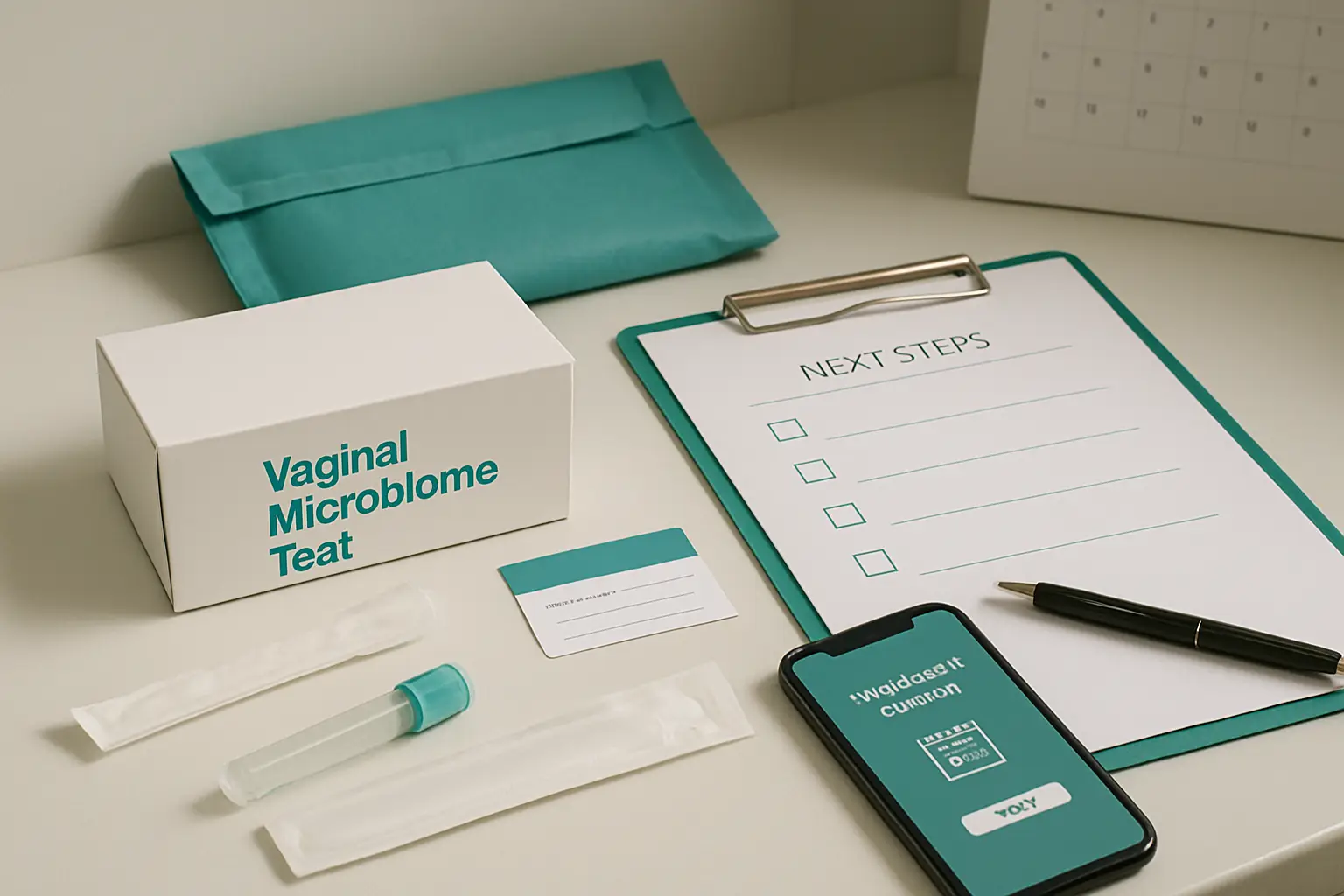
A consumer vaginal microbiome test and a clinical BV test are not interchangeable. The consumer test may provide educational information about bacterial composition and relative patterns in a submitted sample. Clinical BV testing is chosen and interpreted in the context of symptoms, examination, medical history, and validated diagnostic methods such as Amsel criteria, Nugent scoring, or appropriate molecular assays. Use clinical testing when diagnosis or treatment is the goal.
People comparing a vaginal microbiome test vs BV test are often trying to answer one of two questions: “What does my vaginal bacterial community look like?” or “Do my symptoms mean I have bacterial vaginosis?” Those are different questions and require different tools.
MicrobiomeTest.us sells an at-home Vaginal Microbiome Test intended for information gathering and follow-up discussions. Its product page explicitly states that it does not diagnose infection, disease, or another medical condition.
Symptoms should not be sorted by a wellness report alone
Vaginal symptoms can have overlapping causes. CDC guidance notes that history alone is not enough for accurate diagnosis of vaginitis; examination and laboratory testing may be needed. Treating the wrong condition can delay appropriate care.
What a vaginal microbiome wellness test does
It describes a submitted sample
A microbiome report may organize detected bacterial groups, relative abundance patterns, and educational explanations. The result is a snapshot of the collected sample, not a permanent definition of vaginal health.
It may support better questions
A consumer may use the report to prepare for a conversation about recurring concerns, routine changes, or whether professional follow-up makes sense. The report should be read with the product’s stated limitations.
It does not establish the cause of symptoms
A wellness report cannot by itself determine whether symptoms are caused by BV, candidiasis, trichomoniasis, another sexually transmitted infection, irritation, a dermatologic condition, hormonal change, or another cause.
What a clinical BV test does
Bacterial vaginosis is a clinical condition associated with a shift in vaginal bacteria. In the United States, clinicians may use examination, vaginal pH and microscopy-based criteria, Gram-stain scoring, or validated molecular tests depending on the setting.
Amsel criteria and Nugent scoring
Amsel criteria use a combination of clinical and microscopy findings. Nugent scoring evaluates a Gram-stained vaginal sample. These methods are designed for diagnostic use rather than broad consumer wellness profiling.
Molecular BV tests
CDC guidance describes FDA-cleared molecular panels and other validated laboratory-developed assays that detect patterns associated with BV. CDC recommends BV molecular assays for symptomatic patients because performance in people without symptoms is not well defined.
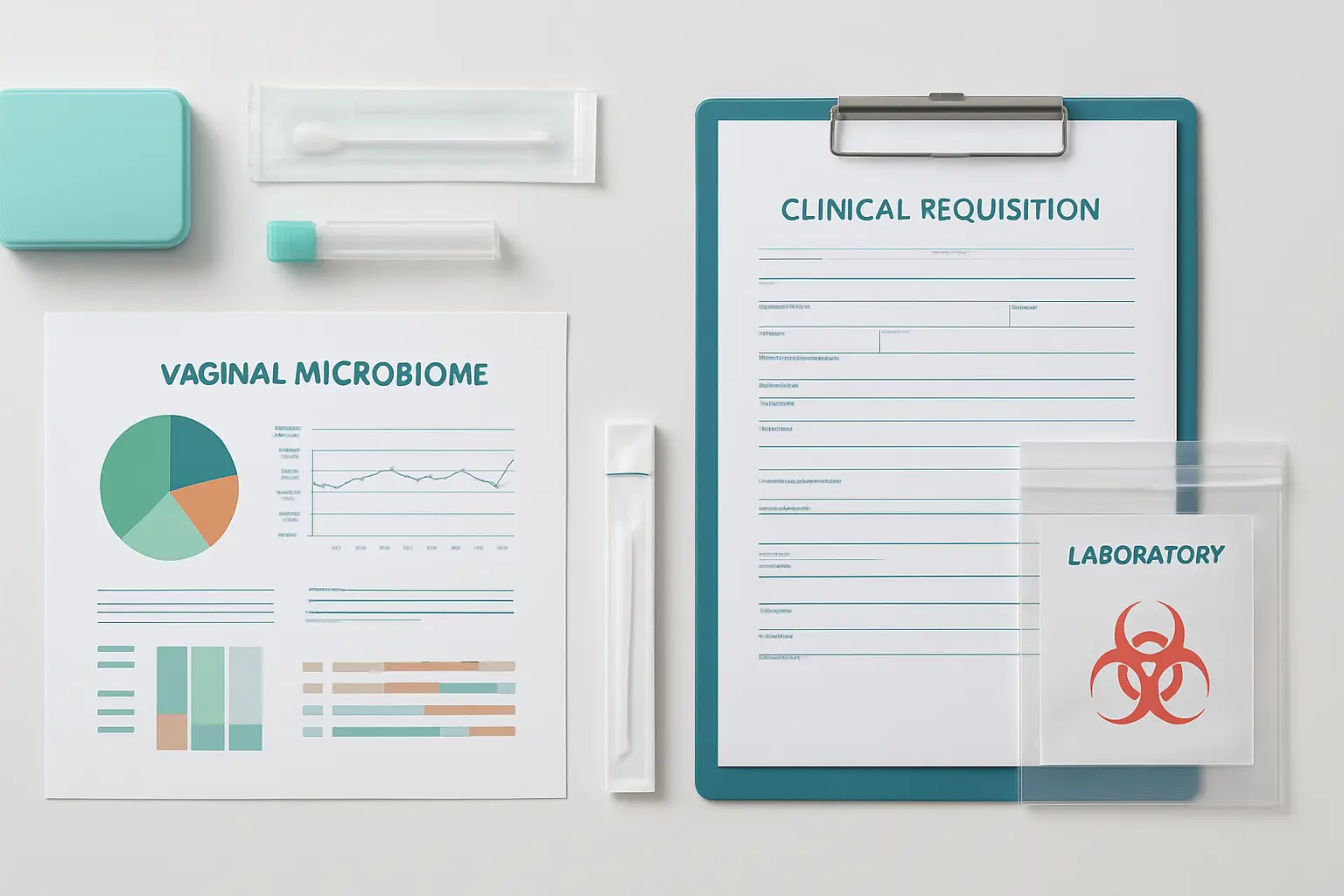
Vaginal microbiome test vs BV test comparison
| Question | Vaginal microbiome wellness test | Clinical BV evaluation or test |
|---|---|---|
| Primary goal | Educational bacterial-composition and wellness context | Help diagnose BV in the context of symptoms and clinical care |
| Interpretation | Consumer report with stated limitations | Clinician or qualified laboratory interpretation |
| Can it diagnose BV? | No, unless a specific regulated diagnostic use is clearly stated | Yes, when an appropriate validated method is used correctly |
| Can it rule out yeast or an STI? | No | Only when the correct additional tests are ordered |
| Best fit | Wellness education and organized follow-up questions | Symptoms, recurrence, pregnancy concerns, or treatment decisions |
Which test should you choose when symptoms are present?
Clinical evaluation is the appropriate path when the goal is to explain symptoms or choose treatment. BV, candidiasis, and trichomoniasis can share symptoms, and symptoms are not specific enough to identify the cause reliably without testing.
New symptoms
Arrange evaluation rather than waiting for a consumer wellness report. A licensed clinician can decide whether microscopy, pH testing, a BV molecular panel, yeast testing, trichomoniasis testing, STI testing, or another examination is appropriate.
Symptoms that return after over-the-counter treatment
CDC guidance recommends clinical evaluation when symptoms persist after over-the-counter candidiasis treatment or recur within two months. A previous episode does not guarantee that a new episode has the same cause.
Pregnancy or possible pregnancy
Contact an obstetric or other licensed healthcare professional about symptoms and testing. Do not use a wellness microbiome report to decide whether treatment is needed during pregnancy.
What if you have no symptoms?
A consumer microbiome test may be considered for educational purposes when you understand its limitations. However, a detected organism or a higher-diversity pattern is not automatically a diagnosis or a reason to start treatment.
CDC guidance states that BV molecular tests should be used among symptomatic patients because their accuracy is not well defined for asymptomatic patients. This is one reason wellness data and clinical diagnostic results should not be treated as the same category.
Does menstrual timing affect a vaginal microbiome snapshot?
Vaginal microbial communities can vary over time. Longitudinal studies have observed higher diversity and lower Lactobacillus abundance during menstruation in some participants, followed by later shifts. This does not mean one cycle phase is universally “bad.” It means collection timing can affect the snapshot.
Use the kit’s cycle and collection instructions
Do not invent a collection day from a general article. Confirm whether the current kit has restrictions related to menstruation, intravaginal medication, recent clinical testing, or other products.
Record context for future comparison
Record the collection date, cycle timing when relevant, recent antibiotics or antifungals, prescribed vaginal medication, hormonal changes, and any symptoms. Do not stop treatment to create a different result.
U.S. care pathways and practical access
Depending on location and availability, evaluation may be available through an OB-GYN, primary-care practice, urgent-care center, public health clinic, community health center, or sexual-health clinic. The appropriate option depends on symptoms, pregnancy status, severity, local access, and insurance or self-pay arrangements.
An at-home wellness kit may be convenient for eligible U.S. delivery addresses, but shipping time and laboratory turnaround are separate from clinical care. Do not wait several weeks for a wellness report when symptoms need timely assessment. Review the site’s shipping information before ordering.
Privacy questions to ask before either test
For a consumer test, review how account details, sample identifiers, laboratory processors, consent, retention, and deletion requests are handled. The site’s privacy and data page outlines the categories a responsible policy should address.
For clinical testing, ask how results enter the medical record, which laboratory processes the sample, how billing is handled, and how you will receive follow-up instructions.
A simple decision framework
Choose clinical testing when
- You have new, persistent, or recurring symptoms.
- You need a diagnosis or treatment decision.
- You are pregnant or have pregnancy-related concerns.
- You need BV, yeast, trichomoniasis, or STI testing.
Consider a wellness test when
- You want educational bacterial-pattern information.
- You understand that it cannot diagnose infection.
- You will not self-treat from one organism or score.
- You are prepared to seek clinical care when needed.
Sources and editorial basis
- Centers for Disease Control and Prevention. Bacterial Vaginosis: STI Treatment Guidelines. Read the CDC guideline.
- Centers for Disease Control and Prevention. Diseases characterized by vulvovaginal itching, burning, irritation, odor, or discharge. Read the CDC overview.
- Centers for Disease Control and Prevention. Vulvovaginal candidiasis: diagnostic and follow-up guidance. Read the CDC guideline.
- Song SD, et al. Daily vaginal microbiota fluctuations associated with the hormonal cycle, contraceptives, diet, and exercise. PubMed record.
- Krog MC, et al. The healthy female microbiome across body sites: effects of hormonal contraceptives and the menstrual cycle. PubMed record.
Editorial scope: consumer test comparison and diagnostic boundaries. This article does not diagnose symptoms or recommend treatment.